
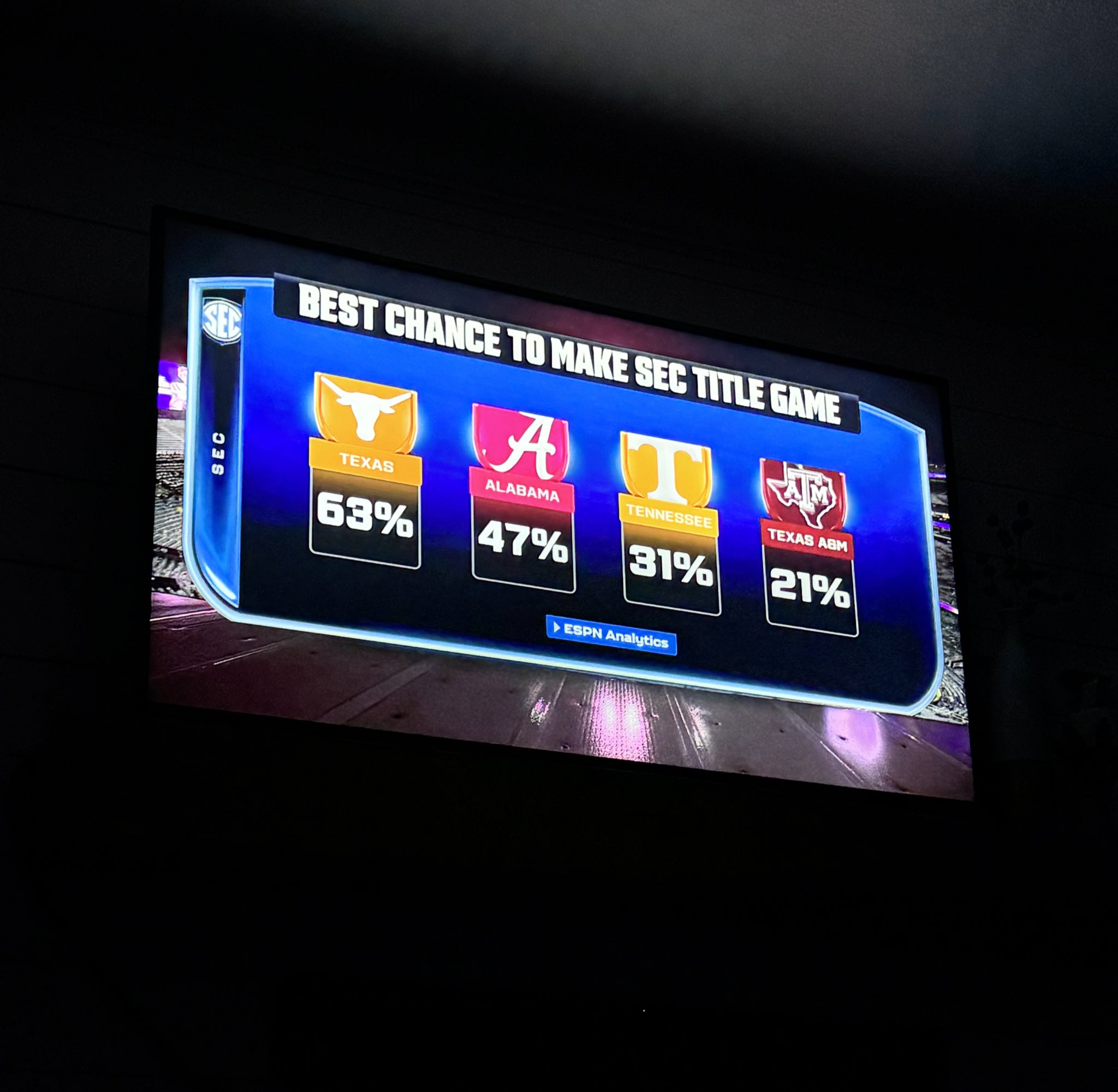
The College Football Playoff (CFP) has become an internet battleground between fans and media analysts. Some accuse ESPN of bias favoring powerhouse programs like Alabama. They believe ESPN prefers any B1G school with a pulse over schools like Tennessee. Is this bias or simply ESPN deciding what is best for everyone?
It’s likely there’s truth in both.
Enter Bud Elliot, an Alabama graduate whose ‘computer model’ recently went viral for favoring Alabama over Tennessee in the playoffs. Bud seems to think Tennessee lost to Vandy and not a 5-4 Arkansas.
But what is his role? Where did he come from? How did he suddenly cultivate a popular podcast and a large twitter following? What and who is really behind this mysterious ‘computer model’? Could it be an echo-chamber of ESPN’s own analytics? Is it uncannily aligned with ESPN’s preferred metrics? Is he just a useful idiot? Or is he a rising Kirk Herbstreit protege and surrogate? Regardless, he is hammering home the ESPN agenda with plausible deniability.
We think that Bud is a cog inside of the ESPN Blob, and this conspiracy is much deeper than Bud Elliot. Bud is just a sports version of Christine Blasey Ford, here for the derailment of Tennessee.


Historic Grudges: Tennessee vs. ESPN
ESPN’s preference for powerhouse programs is clear. It is echoed in on-air analysis featuring familiar SEC alumni. These include the drones of ‘Gator’ Jessie Palmer and Alabama’s Greg McElroy. Their backgrounds lend a sense of credibility and continuity to the network’s narrative. This subtly reinforces ESPN’s College football vision as elite and all-knowing.
Fans of Tennessee, in particular, see this “vision” as a continuation of historical grudges. These grudges might even date back to the Peyton Manning Heisman snub of 1997 or payback for Schiano Sunday.
Lets quickly examine those grudges.
For Tennessee fans, ESPN’s treatment of the Vols brings back memories of the 1997 Heisman race, when Peyton Manning lost to Charles Woodson—a result some trace to ESPN’s support. Remarks by ESPN’s Chris Fowler and Kirk Herbstreit highlight their promotion of Woodson’s unique skill. They also defended Alabama players, like Jermaine Burton who pimp-slapped a Coed Tennessee fan. Fowler’s past comments about Tennessee fans as ‘drunk, snarling, and in a trailer park’ linger in memory. Herbstreit’s opposition to Tennessee’s playoff bid in 2022 also left fans questioning whether old attitudes still persist.
“Schiano Sunday” became a flashpoint for Tennessee fans when ESPN did not support Tennessee’s decision to rescind the offer to Greg Schiano. Instead, ESPN commentators and analysts largely criticized Tennessee’s fanbase and administration for backing out of the deal due to public pressure. Many ESPN commentators seemed to view the fan-driven backlash as excessive or misinformed, implying that such a high-profile decision was not something fans should influence so heavily.
ESPN Analysts Charting Bama’s Path to the Playoffs

ESPN analysts consistently highlight Alabama’s record. This group includes Roman Harper, Tim Tebow, and Paul Finebaum. They emphasize Alabama’s reputation and SEC legacy. In doing so, they frame them as playoff contenders even through setbacks. These analysts focus on the Alabama’s Brand. They highlight Bama’s championship history keeping the Tide in the spotlight as college football’s ‘iconic brand.’ To Tennessee fans, it seems as if this narrative solidifies Alabama’s path forward, leaving little room for other contenders.
Other SEC Network hosts, like Peter Burns and Matt Stinchcomb, highlight Alabama’s strengths. They argue the Tide should remain in the playoff conversation at 10-2 even with a loss to Tennessee and Vanderbilt. Heather Dinich and Sam Acho bolster this view. Dinich breathlessly mentioning Alabama’s “strength of record.” She suggests they belong in the CFP conversation despite two losses (Tennessee and Vanderbilt). For Tennessee fans, this feels like an institutional push to keep Alabama playoff-eligible while downplaying Tennessee’s achievements.
Did I mention Tennessee is the only SEC one-loss team with a Top Ten quality win—and that they beat Bama? And, Arkansas is 5-4?
The Bottom Line: Bias and Narrative Power
In the end, whether ESPN’s narrative is real, or merely perceived, remains uncertain and misguided. Its role as a dominant storyteller shapes public perception. It also influences the future of college football. Tennessee fans hope for fairer representation.
However, powerhouse programs like Alabama remain central to the network’s narrative. Most importantly, ESPN remains firmly in control of the CFB narrative. As a result, the question of bias will continue simmering in the background.

Leave a Reply