
Are Ohio State Fans the Toughest and Most Resilient in College Football?
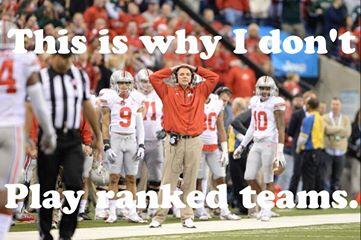
Year after year, the national media showers Ohio State with high rankings, yet the team’s on-field performance often falls short of these lofty expectations. Still, the Buckeye faithful remain steadfast, displaying a loyalty to a brand that borders on irrational.

If Dr. Seuss were to pen a children’s book about handling defeat, he might choose characters more wholesome and whimsical than the actual Ohio State ruffians and brigands. Still, these characters would capture the essence of the Ohio State fan experience: cocky, defiant, and somehow still standing tall after a loss. They’d offer a lesson in resilience—how not to let football disappointment consume your life.
The Peculiar Therapy of Perineum Sunning
After a eye-watering, bone-breaking, soul-crushing defeat, Ohio State fans began to turn to a peculiar form of therapy: perineum sunning (taint tanning) . Buckeye faithful expose their most delicate areas to the healing rays of artificial—and sometimes real—sunlight. The supposed benefits? Boosted energy, enhanced mood, and a restored sense of cosmic balance. After all, who wouldn’t need a good dose of vitamin D in the scrotum or taint after a big loss?

Perineum sunning is an ancient Taoist practice. Taoism claims that the perineum is “The Gate of Life and Death,” a gateway where energy enters and exits the body. For Ohio State fans, it’s a way to absorb disappointment while basking in the warm glow of denial. Who knew taint tanning could offer a spiritual cleanse for bruised egos?
But, as with all things, moderation is key. When the self-proclaimed “Wide Receiver U” room starts booking weekly sunning sessions, it might be time to ask: How much is too much?
The Fragility of Ohio State’s Blue Chip Ratio
As one rival coach put it, “Watching OSU play physical teams from outside the Big Ten is like watching a waterhead struggle to feed a crumpled dollar into a vending machine. No matter how many times they try, the machine just keeps spitting it back out.”
Ohio State’s Blue Chip Ratio (BCR) is another source of stress. The BCR measures the percentage of 4- and 5-star players on a team’s roster. This ratio increases the odds of winning the National Championship. Ohio State’s percentage is an impressive 86%, but let’s not get ahead of ourselves—recruiting evaluations are only as good as the analysts making them. It’s painfully obvious to everyone outside Columbus, Ohio, that these rankings are inflated. When it comes to translating talent into wins, Ohio State often struggles beyond the cozy confines of the B1G.
Let’s be real: if a 4- or 5-star recruit has the option to play for an SEC team, they’re almost certainly heading south.
What Is Resilience?
Consider how Ohio State fans reacted to losing a top recruit to Tennessee. Honestly, it’s exactly what you’d expect from a beleaguered, battered, and disrespected fanbase:
Resilience can be defined as a pattern of positive adaptation in the context of past or ongoing adversity. Over the past 20 years, interest in resilience has surged among Ohio State football fans who have faced repeated setbacks. After losses, especially to Michigan or SEC teams, many Buckeye fans experience a drop in self-esteem, leading to feelings of low self-worth. Hence the budding interest in Taoism in Columbus.
A perfect example is this tweet. The national media, along with recruiting services, boosts Ohio State’s playoff chances. This only sets fans up for disappointment. We all know this is going to end: Tanned taints and brown scrotums.
Has Resilience Gone Too Far?
Is there a point where resilience becomes counterproductive? Has it really helped Ohio State stay competitive on and off the field? A string of embarrassing losses to Michigan allegedly led to the Connor Stalions scandal in 2023. Ohio State, to its own detriment, became laser-focused on the NCAA investigation into the Michigan program.
Today, Michigan occupies significant mental real estate in Ohio State’s collective psyche. The Buckeyes’ hatred for Michigan is so intense that they were willing to sacrifice on-field success if it meant ruining Michigan’s program (more on this later).
Understandably, Ohio State fans who experience adversity often bounce back even stronger—and sometimes more belligerent. Over the years, researchers have identified several internal factors contributing to psychological resilience. These factors enable fans not only to bounce back but to thrive under challenging conditions.
Ohio State’s Record Against the SEC

Ohio State has never beaten Tennessee or South Carolina (or pretty much any team from the SEC). This fact underscores the challenges the Buckeyes face when playing physical teams outside the Big Ten. Resilience through perineum sunning is now recognized as a process that any Buckeye fan is capable of embracing. This capability, if properly harnessed, can be nurtured and cultivated, profoundly influencing the lives of other suffering Buckeye fans.
As mentioned earlier, Ohio State is consistently ranked in the top 3 each season, with expectations through the roof. Perhaps the national media should stop raising these fans’ hopes. This would be for the sake of their mental health. It would also help their tattered but tanned taints.



Leave a Reply